
Monday, 24 October 2016

Friday, 7 October 2016
Reintroduction of Eurasian Beavers to the UK Regenerates Ecosystem
 |
| Source; BBC Earth |
Thursday, 26 November 2015
Female Genital Mutilation
http://aplus.com/a/nigeria-bans-genital-mutilation?so=863e-aa69-101d2-d17b
Tuesday, 10 November 2015
Divorces Fell by 20% Since 2002
According to official statistics, the number of divorces in England & Wales fell from 147,735 in 2002 to 118,140 in 2012. That's a drop of 20% in ten years:
 |
| Source: ONS |
In fact it's down from a high of 165,018 in the early 1990s.
Add to that the number of people who can now get married for the first tome thanks to same sex marriages and you could say that the institution of marriage is experiencing somewhat of a resurgence. There were 10,000 new civil civil partnerships in 2006 alone following it's introduction, for example.
Still Births Have Fallen Drastically Since 1927
The death of a baby is amongst the most tragic and heartbreaking thing for any individual to bear. The definition of a stillbirth is any baby born after 24 or more weeks completed gestation that did not, at any time, breathe or show signs of life.
Thankfully, such events are increasingly rare. According to official statistics the number of stillbirths in the late 1920s and early 1930s was as high as 42 per 1000 births. Nowadays, it's fewer than 6 per 1000 births:
That amounted to a staggering 28,000 stillbirths per year compared to fewer than 4,000 today, even more amazing taking into account that the population of the UK was two thirds of what it was now.
Note the huge drop in stillbirths thanks to the introduction of the NHS in 1948. Those seeking to dismantle the NHS would do well to heed that as a warning of the effects of removing people's access to free healthcare.
Thankfully, such events are increasingly rare. According to official statistics the number of stillbirths in the late 1920s and early 1930s was as high as 42 per 1000 births. Nowadays, it's fewer than 6 per 1000 births:
 |
| Source: ONS |
Note the huge drop in stillbirths thanks to the introduction of the NHS in 1948. Those seeking to dismantle the NHS would do well to heed that as a warning of the effects of removing people's access to free healthcare.
Wednesday, 4 November 2015
Marked Improvement in Weather Reporting Accuracy Since 1980
The much maligned weather man gets a raw deal, it would seem. The accuracy of weather reports is improving steadily thanks to multi-million pound super computing installations that can more accurately model the weather patterns.
The following graph shows how, since 1980, the 3 day forecast has improved from around 85% to just under 100%. Likewise, the ten day forecast has improved from just 30% in 1995 to around 45%:
As the BBC report puts it, overall, the accuracy of the forecast has improved hugely over the last four decades. Our current five-day forecast is as good as our three-day forecast was about 20 years ago. Our useful forecast window has increased by an extra day every 10 years.
The following graph shows how, since 1980, the 3 day forecast has improved from around 85% to just under 100%. Likewise, the ten day forecast has improved from just 30% in 1995 to around 45%:
 |
| Source: BBC |
Friday, 2 October 2015
Technology Keeps Getting Smaller, Faster, Better & Cheaper
Did you ever wonder how it is that today you can buy a handheld smartphone that's got way more computing capacity in it than all of NASA used to land man on the moon? More than IBM used to beat chess grandmaster Gary Kasparov at chess? And all for £150 or so for a basic model?
The answer is that computing technology - processors, memory and storage - is getting exponentially smaller, faster, better and cheaper over time. It's so cheap that we can be frivolous with it today in fact. Flappy Birds, SnapChat, Tinder, kitten memes and terrabytes of selfies.
The only reason this is possible is that somewhere, in some research and development lab of a computer components manufacturer, boffins are slaving away to make the components of your phones and computers smaller, faster, better and cheaper.
Take processors, for example, the brains of your phone and computer. What makes them keep getting faster, smaller, and consuming less power than those of yesteryear is principally down to the fact that each generation is manufactured to be smaller than the last. This means that today's processors can either be smaller and use less energy, or cram more transistors in than the last generation of processors - or both.
Take this, somewhat elderly, graph showing how many transistors are crammed onto today's processors compared to those in 1971:
That's possible because the size of the transistors - the zero / one switches at the heart of any processor - can now be manufactured in mind blowingly small sizes. The sorts of sizes we're talking about here are tiny, measured in nanometers, which are equal to one billionth of a metre ( 0.000000001 m).
The answer is that computing technology - processors, memory and storage - is getting exponentially smaller, faster, better and cheaper over time. It's so cheap that we can be frivolous with it today in fact. Flappy Birds, SnapChat, Tinder, kitten memes and terrabytes of selfies.
The only reason this is possible is that somewhere, in some research and development lab of a computer components manufacturer, boffins are slaving away to make the components of your phones and computers smaller, faster, better and cheaper.
Take processors, for example, the brains of your phone and computer. What makes them keep getting faster, smaller, and consuming less power than those of yesteryear is principally down to the fact that each generation is manufactured to be smaller than the last. This means that today's processors can either be smaller and use less energy, or cram more transistors in than the last generation of processors - or both.
Take this, somewhat elderly, graph showing how many transistors are crammed onto today's processors compared to those in 1971:
 |
| Source: go-rbcs.com |
As recently as the year 2000, transistors were 130nm in size, which is still pretty small. But that's nothing, we'll soon be mass manufacturing transistors less than 10nm in size, whilst 7nm transistors have already been demonstrated in a lab. That's an incredible reduction in component size:
 |
| Source: qph.is.quoracdn.net |
Those boffins keep on breaking down technical barriers preventing progress in building things at unfathomably small sizes, and processors keep getting smaller, faster, better and cheaper as a result.
That's why your next phone will be able to load Flappy Birds that bit quicker than your last phone.
That's why your next phone will be able to load Flappy Birds that bit quicker than your last phone.
Friday, 11 September 2015
Road Fatalities Halved Since Year 2000
According to official government statistics, overall road fatalities in the UK has halved since the year 2000.
The statistics refer to personal injury accidents on public roads (including footways) which become known to the police within 30 days. In particular, damage-only accidents, with no human casualties or accidents on private roads or car parks are not included.
As the following graph shows, overall fatalities halved from 3,409 in the year 2000 to 1,713 by the year 2013:
The biggest drop in fatalities were for car occupants, due to increasingly safe car designs, and also pedestrians which have more than halved since 2000. The smallest drop was for cyclist fatalities, which still dropped 15%.
The statistics refer to personal injury accidents on public roads (including footways) which become known to the police within 30 days. In particular, damage-only accidents, with no human casualties or accidents on private roads or car parks are not included.
As the following graph shows, overall fatalities halved from 3,409 in the year 2000 to 1,713 by the year 2013:
 |
| Source: UK.GOV statistics |
Tuesday, 18 August 2015
Recycling - We No Longer Just Landfill Our Rubbish
It's not so very long ago that once you'd finished using an item you'd bought, you chucked it in the bin (singular) and it got buried in a huge hole in the ground somewhere. Plastics, glass, batteries, food waste, oil cans, paper - the lot. A refined resource, used for the briefest of time, and then buried in landfill to decompose forever more.
Nowadays it seems unthinkable for most of us to not recycle our waste packaging. If you're stuck in a place without recycling bins with an empty can or bottle it feels uncomfortable to just bin it with everything else. If you have a type of plastic packaging which the local council won't accept in their collections it just feels weird not adding it to one of your recycling boxes. And all this is a surprisingly recent phenomenon in the UK.
As recently as the mid 1990s that most areas of the UK had no real recycling schemes in place. Only conscientious folks with enough time on their hands took their bottles and cans to bottle banks, there were no home collections. Even the traditional bottled milk collection and bottle return system was on the wane, and the pop bottle coin deposit schemes of the 50's and 60's had all but died out. Visitors from more enlightened European countries reported feeling the same un-comfortableness binning bottles and cans as we do today.
But all that began to change by the turn of the millennium, and now recycling rates in England have jumped from 11% to 42%:
Waste products like plastics and cans are both increasingly recycled where once they were just buried:
But there's still a long way to go to eradicate the remaining landfill waste which cannot be recycled. One suggestion is that there should be more Energy From Waste (EFW) incineration plants in the UK like in many other countries, which would put much of the remaining 75% of un-recycled waste to good use, rather than being left to decompose into its constituent waste gasses in an ugly hole in the ground:
That way the UK could incinerate about 50% of its waste to generate energy, recycle most of the rest and only landfill a tiny remainder, just like in countries like Denmark and Sweden.
Nowadays it seems unthinkable for most of us to not recycle our waste packaging. If you're stuck in a place without recycling bins with an empty can or bottle it feels uncomfortable to just bin it with everything else. If you have a type of plastic packaging which the local council won't accept in their collections it just feels weird not adding it to one of your recycling boxes. And all this is a surprisingly recent phenomenon in the UK.
As recently as the mid 1990s that most areas of the UK had no real recycling schemes in place. Only conscientious folks with enough time on their hands took their bottles and cans to bottle banks, there were no home collections. Even the traditional bottled milk collection and bottle return system was on the wane, and the pop bottle coin deposit schemes of the 50's and 60's had all but died out. Visitors from more enlightened European countries reported feeling the same un-comfortableness binning bottles and cans as we do today.
But all that began to change by the turn of the millennium, and now recycling rates in England have jumped from 11% to 42%:
 |
| Source: Insomnia.co.uk |
 |
| Source: Recoup.org |
 |
| Source: Sustain-ed.org |
 |
| Source: Arc21.org.uk |
Monday, 3 August 2015
The Internet - Knowledge is Power
The ability for the knowledge of mankind to progress and develop is dependent upon people observing a phenomenon, investigating its cause and publishing their findings for others to see. Historically, back when literacy was in the hands of the few, and the distance over which knowledge could be transmitted was very short, it was difficult for somebody to be able to document a piece of knowledge and have it read by enough people to ensure it was transmitted down the generations.
Consequently, whatever it was that caused the small population of Mesolithic people who built Stonehenge to do so is lost in the mists of time. Likewise, while ancient people could build complex machinery such as the Antikythera mechanism as early as 150 BC, perhaps inspired by the work of Archimedes, the secrets of its purpose, design and usage were not passed on to others, meaning it was centuries before such mechanisms were possible again. If knowledge isn't written down and passed on to others, it runs the risk of dying out within a generation and setting back progress hundreds of years before somebody else comes up with the same idea.
Since literacy was traditionally only available to the elite or the hierarchy of the church, the common man was barred from being able to read others work or write down their own observations. In pre-modern times it is unlikely that literacy was found in more than about 30-40% of the population, meaning that 60-70% of people were out of the equation of book learning altogether. This was true in England as late as the mid-Victorian era before compulsory education kicked in.
For centuries, the only way for a book to be duplicated was for it to be laboriously copied out by hand by scribes, which mean that books were outrageously expensive and limited in number. It is said that the 17th century poet John Milton, although blind towards the end of his life, was the last person to know everything because he had read virtually every book ever written at that time.
Given the small numbers of each book that existed, on numerous occasions library fires wiped out every last copy of a given work. Consequently, the list of lost literary works is long and harrowing, and who knows how much quicker knowledge would have advanced if those works had been duplicated and distributed before they were lost?
Then Gutenberg invented moveable type in 1439, and the cost of reproducing books came down drastically. The number of books published in Europe ballooned, directly enabling both the Renaissance and scientific revolution:
So the simple ability to publish works dragged humanity out of the dark ages. Even then, the ability for a person to record and distribute their ideas was limited by having the financial resources to allot the time to write a book and the backing of a publisher to print and distribute it. That limitation was only overcome with the arrival of the Internet in the 1990s.
Nowadays, it's possible for anyone with access to relatively cheap computer equipment, or even a tablet or smartphone, to publish their thoughts to the entire on-line world. Social media allows tweets and statuses to be broadcast instantly around the world, free blogs like this one allow publication of longer thoughts, ideas and concepts and cheaply hosted websites allow grander schemes to be demonstrated to the world. The number of 'authors' can therefore be said to have ballooned well beyond traditional book authoring since the arrival of the Internet:
Now, clearly there's a question over whether more quantity necessarily means more quality, and quite a bit of internet content is limited to kitten pictures and smut. However, the number of people that a given on-line publication can theoretically reach is now heading towards 3 billion:
The fastest Internet user growth rates can be found in third world countries where access to education has traditionally been limited, reaching up to 17% growth per year in many African countries:
Consequently, whatever it was that caused the small population of Mesolithic people who built Stonehenge to do so is lost in the mists of time. Likewise, while ancient people could build complex machinery such as the Antikythera mechanism as early as 150 BC, perhaps inspired by the work of Archimedes, the secrets of its purpose, design and usage were not passed on to others, meaning it was centuries before such mechanisms were possible again. If knowledge isn't written down and passed on to others, it runs the risk of dying out within a generation and setting back progress hundreds of years before somebody else comes up with the same idea.
Since literacy was traditionally only available to the elite or the hierarchy of the church, the common man was barred from being able to read others work or write down their own observations. In pre-modern times it is unlikely that literacy was found in more than about 30-40% of the population, meaning that 60-70% of people were out of the equation of book learning altogether. This was true in England as late as the mid-Victorian era before compulsory education kicked in.
For centuries, the only way for a book to be duplicated was for it to be laboriously copied out by hand by scribes, which mean that books were outrageously expensive and limited in number. It is said that the 17th century poet John Milton, although blind towards the end of his life, was the last person to know everything because he had read virtually every book ever written at that time.
Given the small numbers of each book that existed, on numerous occasions library fires wiped out every last copy of a given work. Consequently, the list of lost literary works is long and harrowing, and who knows how much quicker knowledge would have advanced if those works had been duplicated and distributed before they were lost?
Then Gutenberg invented moveable type in 1439, and the cost of reproducing books came down drastically. The number of books published in Europe ballooned, directly enabling both the Renaissance and scientific revolution:
 |
| Source: Wikipedia |
Nowadays, it's possible for anyone with access to relatively cheap computer equipment, or even a tablet or smartphone, to publish their thoughts to the entire on-line world. Social media allows tweets and statuses to be broadcast instantly around the world, free blogs like this one allow publication of longer thoughts, ideas and concepts and cheaply hosted websites allow grander schemes to be demonstrated to the world. The number of 'authors' can therefore be said to have ballooned well beyond traditional book authoring since the arrival of the Internet:
 |
| Source: Seed Magazine - A Writing Revolution |
 |
| Source: Internet Live Stats |
The fastest Internet user growth rates can be found in third world countries where access to education has traditionally been limited, reaching up to 17% growth per year in many African countries:
 |
| Source: Internet Live Stats |
Since the first website went on-line in 1991 there are now a staggering 980 million websites out there:
 |
| Source: Internet Live Stats |
So, perhaps you might want to limit yourself to reading the five million articles in English on Wikipedia (launched 2001), or buying one of the 32.8 million books from Amazon (launched 1995), or watching some of the 300 hours of video uploaded to YouTube every minute (launched 2005), or maybe the collected thoughts of 1.5 billion Facebook users (launched 2004) and 300 million Twitter users (launched 2006). Or maybe one of the numerous free on-line book repositories with thousands of titles available for free.
Given that little lot, the chances of another John Milton reading everything that had ever been published are exactly zero. The democratisation of published knowledge has well and truly arrived.
Tuesday, 7 July 2015
All Hail the Smartphone
Given the ubiquity of smartphones, it's difficult to remember a time before they were here. Which is all the more amazing since the event that spurred them into popularity, the launch of the first iPhone, was in 2007 so we've had less than ten years of them in our lives, and already they are completely indispensable.
From that iPhone launch in 2007 there are now nearly 2 billion smartphones in the world as of 2015, which is predicted to rise to 2.56 billion by 2018.
When the iPhone launched in 2007 it debuted at $499 or $599 depending on model, whereas now you can buy landfill Android handsets for as little as $30. So we're not talking elite purchases, we're talking about fully democratised pocket computing, which is why the next billion internet users are expected to be mobile-only. This is why Google's Android One programme is targeting low end phones at the Asian market for around the $100 mark.
Or to put it another way, when the most powerful supercomputer in the world, IBM's Deep Blue supercomputer, beat chess grand master Gary Kasparov in 1997 it did so with a then staggering 11.38 GFLOPS of processing power (where a gigaflop is a billion calculations a second). Today you can get a reasonably good phone like the Samsung Galaxy S5 which will do 142 GFLOPS in your pocket. Or indeed high-end phones using the same processor as the Google Nexus 9 that will do 364 GFLOPS.
How's that game of Flappy Birds coming on?
From that iPhone launch in 2007 there are now nearly 2 billion smartphones in the world as of 2015, which is predicted to rise to 2.56 billion by 2018.
 |
| Source: eMarketer |
The following Radio Shack catalogue advert from 1991 shows computers, phones, camcorders, cameras, dictaphones, music players etc., all of which are nowadays redundant items thanks to that phone in your pocket. Just to put this technological leap in perspective, in 1991 you would have paid $3.56 million to buy the equivalent gadgets individually and corresponding computing power that would duplicate the functionality of an iPhone today:
 |
| Radio Shack catalogue from 1991 |
In fact, you can easily run PlayStation 2 games on your phone nowadays, which back in the year 2000 took the best selling games console ever to run.
Today, your mobile phone has way more computer power than all of NASA back in 1969, when it placed two astronauts on the moon. And NASA had multiple rooms full of IBM System/360 Model 75 mainframe computers, costing up to $3.5 million apiece plus the computers on board the Apollo spacecraft themselves.
Today, your mobile phone has way more computer power than all of NASA back in 1969, when it placed two astronauts on the moon. And NASA had multiple rooms full of IBM System/360 Model 75 mainframe computers, costing up to $3.5 million apiece plus the computers on board the Apollo spacecraft themselves.
Or to put it another way, when the most powerful supercomputer in the world, IBM's Deep Blue supercomputer, beat chess grand master Gary Kasparov in 1997 it did so with a then staggering 11.38 GFLOPS of processing power (where a gigaflop is a billion calculations a second). Today you can get a reasonably good phone like the Samsung Galaxy S5 which will do 142 GFLOPS in your pocket. Or indeed high-end phones using the same processor as the Google Nexus 9 that will do 364 GFLOPS.
How's that game of Flappy Birds coming on?
Thursday, 2 July 2015
Gay Marriage Increasingly Legalised Across World
Now that the USA has formally legalised same sex marriage across all its states, the world has taken another step towards inclusiveness. It's part of an ongoing trend not to exclude consenting same-sex adult couples from designating their pledge to spend the rest of their lives together as marriage, just the same as we heterosexual married couples do.
For the past few hundred years of our 200,000 year history as a species, we in the West have had our definition of marriage constrained to a simple 'man + woman' pattern as defined by somebody as the 'biblical ideal' of marriage. Only now are those constraints being challenged, which is particularly timely because as of the 2011 census, 40% of Brits do not regard themselves as Christians and increasingly many do not really see why the church should be able to impose its narrow definition of marriage on them too.
Marriage has, of course, had a much older history than the comparatively recent Christian era. There was marriage in the pre-Christian ancient Greek and Roman worlds as indeed there was in the rest of pagan Europe, and those societies defined marriage according to their own definitions. Same sex marriages were going on during the Greek and Roman period as a fairly common practice. Same sex marriage even persisted in Europe as late as 1061. It seems that same-sex 'Boston Marriage' cohabitation between two women was tolerated in New England as late as the Victorian era.
Even more bizarrely, the Bible itself doesn't actually constrain its definition of marriage to the 'man + woman' template anyway, as this excellent infographic shows. If the Bible itself defines your spouse as loosely as potentially including your brother's widow, your concubines, your rape victim, your wife's slaves, your prisoner of war, your multiple polygamous wives and even your assigned slave partner, then what hope do we have of constraining marriage to a meaningful biblical definition?
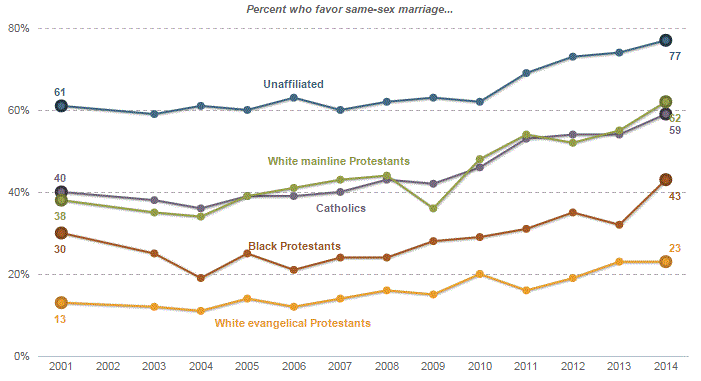
Increasingly, even the deeply religious country that is the USA now supports same sex marriage, which is reflected in their recent Congress vote, with similar results in Europe and Australia. Around 10% more of American people from all faiths and non-faiths are now receptive to gay marriage than they were in 2001. Figures range from 77% of non-affiliated people approving it, down to 23% of white evangelical protestants approving it, where a 10% increase is quite a shift in opinions in such a short space of time:
The Netherlands was the first country to legalize same-sex marriages in 2001. As of 26 June 2015, eighteen countries have legalised same sex marriage with the practice recognised in six more. Civil unions and registered partnerships are recognised in some or all of 22 further countries and unregistered cohabitation recognised in four more.
That's an amazing increase in just 14 years and it shows the progress being made in simply letting two people who love each other proclaim their intent to stay together in front of their nearest and dearest.
 |
| Source: BBC News |
Marriage has, of course, had a much older history than the comparatively recent Christian era. There was marriage in the pre-Christian ancient Greek and Roman worlds as indeed there was in the rest of pagan Europe, and those societies defined marriage according to their own definitions. Same sex marriages were going on during the Greek and Roman period as a fairly common practice. Same sex marriage even persisted in Europe as late as 1061. It seems that same-sex 'Boston Marriage' cohabitation between two women was tolerated in New England as late as the Victorian era.
Even more bizarrely, the Bible itself doesn't actually constrain its definition of marriage to the 'man + woman' template anyway, as this excellent infographic shows. If the Bible itself defines your spouse as loosely as potentially including your brother's widow, your concubines, your rape victim, your wife's slaves, your prisoner of war, your multiple polygamous wives and even your assigned slave partner, then what hope do we have of constraining marriage to a meaningful biblical definition?
 |
| Source: Upworthy.com |
 |
| Source: Pewforum |
That's an amazing increase in just 14 years and it shows the progress being made in simply letting two people who love each other proclaim their intent to stay together in front of their nearest and dearest.
Pandemic Plagues a Thing of the Past
Since the dawn of time, humanity has been periodically overrun by terrible plagues and diseases. So it's hardly surprising we have an ingrained dread of epidemics still to this day.
Since its discovery in 1981, AIDS has caused an estimated 36 million deaths worldwide, which is a terrifying number for those in the regions most affected. The Ebola outbreak on West Africa was a terrible episode, which as of May 2015 had claimed 10,900 lives. Similarly, the SARS outbreak in South East Asia sent communities into a panic and has so far resulted in 775 deaths.
But, terrible though AIDS, Ebola and SARS are for those affected by its appalling symptoms, in terms of the percentage of the population of the day killed, they're often dwarfed by the plagues of yore. This demonstrates how far humanity has come in preventing and treating infectious diseases. This is not in any way to trivialise the plight of those living under the shadow of a modern day epidemic, but it is intended to provide some context to just how good humanity has become at shielding itself from the diseases of the natural world in modern times.
In classical times, when populations were tiny by comparison to today's urban based concentrations of millions of people, it was not uncommon to have plagues that would wipe out hundreds of thousands of people at a time and take out 30% - 40% of a given population.
By the mediaeval era there were great plagues like the Black Death in the 14th century, from which the total number of deaths worldwide is estimated at an appalling 75 million people, approximately 25–50 million of which occurred in Europe. That's a staggering 30% to 70% of population killed between 1346 and 1350 alone. The plague is thought to have returned every generation with varying virulence and mortalities until the 1700s. During this period, more than 100 plague epidemics swept across Europe.
Other smaller outbreaks of diseases include the 17th century outbreak of leptospirosis that killed 90% of the population of southern New England. or cholera pandemics that killed 100,000 people at a time in successive outbreaks in the 19th century, and a million people in Russia alone between 1852 and 1860. Likewise, Typhus outbreaks such as the one that killed 20,000 people in Canada in the mid nineteenth century.
Fortunately, nowadays the plague that caused the Black Death can be treated with insecticides, antibiotics and prevented by a vaccine. Likewise, Typhus can be treated with antibiotics and its insect-borne cause prevented via a vaccination. Cholera can be treated using simple oral hydration therapies with its cause through poor sanitation removed better isolation of sewerage from the drinking water supply.
Meanwhile, our treatment of modern day diseases is improving all the time too. HIV / AIDs can be slowed dramatically by the use of antiviral therapies and prevented by safe sex and prevention of blood contamination. The quest to develop a SARS vaccine is ongoing, as is the quest to develop an Ebola vaccine but containment for both is capable of halting the epidemic in its tracks.
Modern epidemiology and drug research will one day remove these diseases from circulation, just like it has done for the terrible plague, typhus and cholera diseases that once wiped out huge swathes of humanity.
Since its discovery in 1981, AIDS has caused an estimated 36 million deaths worldwide, which is a terrifying number for those in the regions most affected. The Ebola outbreak on West Africa was a terrible episode, which as of May 2015 had claimed 10,900 lives. Similarly, the SARS outbreak in South East Asia sent communities into a panic and has so far resulted in 775 deaths.
But, terrible though AIDS, Ebola and SARS are for those affected by its appalling symptoms, in terms of the percentage of the population of the day killed, they're often dwarfed by the plagues of yore. This demonstrates how far humanity has come in preventing and treating infectious diseases. This is not in any way to trivialise the plight of those living under the shadow of a modern day epidemic, but it is intended to provide some context to just how good humanity has become at shielding itself from the diseases of the natural world in modern times.
In classical times, when populations were tiny by comparison to today's urban based concentrations of millions of people, it was not uncommon to have plagues that would wipe out hundreds of thousands of people at a time and take out 30% - 40% of a given population.
 |
| Source: Listverse |
Other smaller outbreaks of diseases include the 17th century outbreak of leptospirosis that killed 90% of the population of southern New England. or cholera pandemics that killed 100,000 people at a time in successive outbreaks in the 19th century, and a million people in Russia alone between 1852 and 1860. Likewise, Typhus outbreaks such as the one that killed 20,000 people in Canada in the mid nineteenth century.
Fortunately, nowadays the plague that caused the Black Death can be treated with insecticides, antibiotics and prevented by a vaccine. Likewise, Typhus can be treated with antibiotics and its insect-borne cause prevented via a vaccination. Cholera can be treated using simple oral hydration therapies with its cause through poor sanitation removed better isolation of sewerage from the drinking water supply.
Meanwhile, our treatment of modern day diseases is improving all the time too. HIV / AIDs can be slowed dramatically by the use of antiviral therapies and prevented by safe sex and prevention of blood contamination. The quest to develop a SARS vaccine is ongoing, as is the quest to develop an Ebola vaccine but containment for both is capable of halting the epidemic in its tracks.
Modern epidemiology and drug research will one day remove these diseases from circulation, just like it has done for the terrible plague, typhus and cholera diseases that once wiped out huge swathes of humanity.
Thursday, 25 June 2015
Pope Re-States Catholic Church's Belief in Evolution and the Big Bang
That historic bastion of scientific suppression known as the papacy has come out publicly to reaffirm the Catholic church's belief in Evolution and the Big Bang.
Given that it is over 150 years since Charles Darwin published On The Origin of Species you would have thought that the battle to convince the public that evolution could be explained by natural means would have been pretty much done and dusted a long time ago.
Yet, staggeringly, there remains a worrying large proportion of people in the UK and elsewhere that believe everything was created by a god as-is, or that their god has been manually tweaking things from the heavens throughout history.
In the UK around 80% of people believe in evolution, meaning that the number of people who do not believe in evolution has dropped to below 1 in 5, with a few not sure. That beats the USA where only 40% of people believe in evolution:
According to a poll run by Gallup, which asked the American public whether species were created, evolved with a god's help or evolved without a god, 42% of American people are straight-up creationists, who don't believe in evolution at all, be it god guided or otherwise! Thankfully, the percentage of US 'natural selection' evolutionists has risen from just 9% in 1982 to 19% today:
If even the Pope can come to terms with the scientific facts, perhaps its time for the majority of the world's population to read up on Darwin's 150 year old book and follow suit?
Here's a BBC Bitesize GCSE revision guide to be getting on with: LINK and a Dummies Guide: LINK
Given that it is over 150 years since Charles Darwin published On The Origin of Species you would have thought that the battle to convince the public that evolution could be explained by natural means would have been pretty much done and dusted a long time ago.
Yet, staggeringly, there remains a worrying large proportion of people in the UK and elsewhere that believe everything was created by a god as-is, or that their god has been manually tweaking things from the heavens throughout history.
In the UK around 80% of people believe in evolution, meaning that the number of people who do not believe in evolution has dropped to below 1 in 5, with a few not sure. That beats the USA where only 40% of people believe in evolution:
 |
| Source: Wikipedia |
 |
| Source; GALLUP |
Here's a BBC Bitesize GCSE revision guide to be getting on with: LINK and a Dummies Guide: LINK
Percentage of UK Children Living in Poverty Has Fallen Since Year 2000
The percentage of children living in poverty has fallen since the turn of the millennium, according to ONS figures quoted on the BBC News website.
The figures show a drop from over 25% of children living in poverty in 1999 / 2000 to just 17% by 2013 / 2014.
The BBC report notes that "A child is defined as being in poverty when living in a household with an income below 60% of the UK's average. Average household income in 2013-14 was £453 a week - making the poverty line £272 a week."
The BBC News article expresses concern that that fall has been partially reversed in this year's figures. However, the latest figures also showed that 9.6 million people were on relative low incomes in 2013 / 2014 which represents a fall of 100,000 on the previous year. This is down from 11.2 million in 1998 / 1999 when comparable records began.
 |
| Source: BBC News |
The BBC report notes that "A child is defined as being in poverty when living in a household with an income below 60% of the UK's average. Average household income in 2013-14 was £453 a week - making the poverty line £272 a week."
The BBC News article expresses concern that that fall has been partially reversed in this year's figures. However, the latest figures also showed that 9.6 million people were on relative low incomes in 2013 / 2014 which represents a fall of 100,000 on the previous year. This is down from 11.2 million in 1998 / 1999 when comparable records began.
Wednesday, 17 June 2015
Computer Games in a Different League
It's difficult to think of a field which is so demonstrates such incredible progress in a short space of time than computer games. Computer games didn't exist at all until some very basic things cobbled together on scientific oscilloscope screens in the 1950s. From that point until today's sprawling, high-definition 3D sandbox landscapes has been quite a journey.
It wasn't until 1972 that the first commercially successful game came about, which was Atari's Pong. Initially, it was only released as a cabinet based arcade game, but subsequently as home gaming systems began to take off in 1975 Atari released it as a dedicated console capable of playing just this one game.
To say Pong was basic would be an understatement. It was black and white, had basic bleep sounds and by virtue of the fact it was plugged into a home TV it was of course standard definition and narrow screen:
Fast forward 40 years to the current crop of games consoles. The recent E3 games expo in Los Angeles saw the announcement of the next crop of games for consoles like Sony's PS4. The PS4 has a CPU with eight 1.6 GHz cores on it and a dedicated graphics processor capable of delivering 1.84 TFLOPS, which basically means it's a bit tidy.
In the hands of today's games designers that means that a PS4 game today looks like this:
Skin textures look increasingly real, water flows realistically and reflects the light perfectly, foliage blows in the breeze and bends as the main character runs through it, the landscape consists of far-off horizons of towering mountains and idyllic towns and ruins.
But that's not all. The video games industry stands on a precipice at the moment, whereby the forthcoming releases of the long-promised technology of virtual reality headsets looks certain to herald a new era of super immersive gaming that will wipe the floor with what's gone before.
Take, for example, the Occulus Rift headset, now owned by web giant Facebook. It has developed to work with games consoles such that the wearer dons the headset and can see the landscape around him in 3D. This is still a pre-release technology at the moment, but it has blown the minds of those doing previews of the technology:
Expect Pong 1975 edition in 3D any time soon. Watch out for that square puck.
It wasn't until 1972 that the first commercially successful game came about, which was Atari's Pong. Initially, it was only released as a cabinet based arcade game, but subsequently as home gaming systems began to take off in 1975 Atari released it as a dedicated console capable of playing just this one game.
To say Pong was basic would be an understatement. It was black and white, had basic bleep sounds and by virtue of the fact it was plugged into a home TV it was of course standard definition and narrow screen:
Fast forward 40 years to the current crop of games consoles. The recent E3 games expo in Los Angeles saw the announcement of the next crop of games for consoles like Sony's PS4. The PS4 has a CPU with eight 1.6 GHz cores on it and a dedicated graphics processor capable of delivering 1.84 TFLOPS, which basically means it's a bit tidy.
In the hands of today's games designers that means that a PS4 game today looks like this:
Skin textures look increasingly real, water flows realistically and reflects the light perfectly, foliage blows in the breeze and bends as the main character runs through it, the landscape consists of far-off horizons of towering mountains and idyllic towns and ruins.
But that's not all. The video games industry stands on a precipice at the moment, whereby the forthcoming releases of the long-promised technology of virtual reality headsets looks certain to herald a new era of super immersive gaming that will wipe the floor with what's gone before.
Take, for example, the Occulus Rift headset, now owned by web giant Facebook. It has developed to work with games consoles such that the wearer dons the headset and can see the landscape around him in 3D. This is still a pre-release technology at the moment, but it has blown the minds of those doing previews of the technology:
Expect Pong 1975 edition in 3D any time soon. Watch out for that square puck.
We're Taller Than Ever, Which Shows We're in Better Health
One nice and simple indicator of how much healthier we all are than we used to be is our height. Today we have a higher income, more sanitary living conditions and better education about health and nutrition than ever before. Add to that lower infant mortality and fewer mouths to feed due to smaller family sizes, and it means that the average person grew up with better nutrition than our ancestors, and it shows in our average height.
For example, by 1971 the average British 21 year old male was 10 cm taller than they were a century earlier in 1871:
And this trend is not just affecting UK males, it's repeated across the globe. The following graph shows upward trends in average height of around 10 cm per person between 1810 and 1980 in every region of the world:
It seems that from skeletal remains found during archaeological digs that average height in Europe bumbled along at around 170 cm for the past two thousand years, before rocketing up to closer to 180 cm as a result of the industrial revolution.
You can say what you like about modern lifestyles, but the stats show we are healthier than ever before.
For example, by 1971 the average British 21 year old male was 10 cm taller than they were a century earlier in 1871:
 |
| Source: BBC News |
 |
| Source: Our World Data |
 |
| Source: Our World Data |
Life Expectancy Nearly Doubled Since 1841
Life today for many of us is more sheltered, more surrounded by material goods and more connected to the outside world than ever before. It's also nearly twice as long as it was in Victorian times.
According to stats from the Office for National Statistics life expectancy in 1841 was around 40 years. By 2010 it had risen to around eighty:
 |
| Source: ONS Mortality in England and Wales: Average Life Span, 2010 |
 |
| Source: ONS Mortality in England and Wales: Average Life Span, 2010 |
And depending on how you measure how long we live, we might expect to live as long as 85 (males) or 89 (females) as a modal average, as the ONS report explains:
"In 2010 life expectancy for a newborn baby boy was 79 years and for a newborn baby girl 83 years. These are the average number of years a baby could expect to live if he or she experienced the mortality rates at each age in 2010 throughout his or her life. An alternative measure of average life span is the age at which half of all deaths occurred before and the other half after (median age at death); in 2010 this was 82 for a man and 85 for a woman, up to three extra years of life than given by life expectancy at birth. The third measure of average life span, the modal age at death, gives a further three or four years of life: 85 and 89 years for a man and woman." - ONS
The difference between the modal average and the other two measures is that the others are skewed by the incredibly high infant mortality rates in the Victorian era which reduce the statistical lifespan of the average UK citizen.
Back in the Victorian era the peak age at people died was around 60-70, whereas by 2010 it was around 85:
 |
| Source: ONS Mortality in England and Wales: Average Life Span, 2010 |
 |
| Source: ONS Mortality in England and Wales: Average Life Span, 2010 |
Monday, 8 June 2015
China is World's Biggest Investor in Renewable Energy
China is currently the world's biggest importer of oil, which combined with its infamous air-pollution problem, is driving the country to reduce its dependence on fossil fuels.
 |
| China's emissions (Source: BBC News) |
According to Forbes magazine, the Renewable Energy Policy Network for the 21st Century report put China once as leading rest of the world in renewable energy investment in 2013, spending a total of $56.3 billion on wind, solar and other renewable projects.
By 2015, according to the Financial Times, China extended its lead over the US in investment in renewable energy, which rose 32 per cent to a record $89.5bn, with about three quarters of that going into wind and solar power.
As the BBC reports, this could mean that China's greenhouse gas emissions could start to decline within 10 years, according to a report from the London School of Economics.
The LSE authors note that "China's pledge includes a commitment to use 'best efforts' to peak before 2030; we are beginning to see the fruits of China's best efforts. China's transformation has profound implications for the global economy, and greatly increases the prospects for keeping global greenhouse gas emissions within relatively safe limits."
Thursday, 21 May 2015
Standard of Living
The standard of living in the UK is something that has risen almost imperceptibly over the decades. It takes somebody who has spent a great many years on the planet, with a good recall of the past, to illustrate how what we regard as every day essentials used to be regarded as impossibly luxuriant dream goods.

Historian and writer William Woodruff wrote of his upbringing in the Blackburn of 1916 in his book The Road to Nab End. In what sounds today like a Pythonesque parody of northern poverty, Woodruff relates about people being woken at 5am, to walk to the mill in their clogs six days a week. Home consisted of a two-up-two-down house with a slate floor dusted with sand downstairs, and a boarded floor upstairs you could see through the gaps of and hear a conversation downstairs as if you were in the room. Woodruff and his brother shared a bed with their parents, and his two sisters shared a bed in the other room. During the depression of the 1920s they went without coal over winter for weeks, and without even stale bread to eat for days at a time.
You tell that to kids nowadays and they don't believe you, etc. etc.....
If you think that's extreme or far fetched, here's some government statistics that back up that what we used to consider an every day necessity sounds today like something out of the ark. And likewise, what we consider necessity today seems like a ridiculously flimsy nice-to-have by comparison.
The government has been measuring inflation using something called the Retail Price Index (RPI) since the 1950s. To do this they defined a shopping basket of 700 common consumer items of the day that they could measure the cost of over time to see whether the cost of living was going up or down. Conveniently, this also shows how our attitudes to what is a 'common consumer item' change over time.
In the 1950s, we regarded a mangle, some candles and some frozen cod as standard consumer items. By the 1970s that basket included Smash mashed potato, cassette recorders and duvets. By the 2000s we regarded MP3 players, mobile phones and fruit smoothies as being equivalent consumer items!
By the RPI basket of 2015 we have added on-line games console subscriptions, e-cigarettes and a streaming music subscription to our basket of essential items.
You tell that to kids in Blackburn in 1916 and they don't believe you, etc. etc.....

Historian and writer William Woodruff wrote of his upbringing in the Blackburn of 1916 in his book The Road to Nab End. In what sounds today like a Pythonesque parody of northern poverty, Woodruff relates about people being woken at 5am, to walk to the mill in their clogs six days a week. Home consisted of a two-up-two-down house with a slate floor dusted with sand downstairs, and a boarded floor upstairs you could see through the gaps of and hear a conversation downstairs as if you were in the room. Woodruff and his brother shared a bed with their parents, and his two sisters shared a bed in the other room. During the depression of the 1920s they went without coal over winter for weeks, and without even stale bread to eat for days at a time.
You tell that to kids nowadays and they don't believe you, etc. etc.....
If you think that's extreme or far fetched, here's some government statistics that back up that what we used to consider an every day necessity sounds today like something out of the ark. And likewise, what we consider necessity today seems like a ridiculously flimsy nice-to-have by comparison.
The government has been measuring inflation using something called the Retail Price Index (RPI) since the 1950s. To do this they defined a shopping basket of 700 common consumer items of the day that they could measure the cost of over time to see whether the cost of living was going up or down. Conveniently, this also shows how our attitudes to what is a 'common consumer item' change over time.
In the 1950s, we regarded a mangle, some candles and some frozen cod as standard consumer items. By the 1970s that basket included Smash mashed potato, cassette recorders and duvets. By the 2000s we regarded MP3 players, mobile phones and fruit smoothies as being equivalent consumer items!
 |
| Source: BBC News in 2009 |
You tell that to kids in Blackburn in 1916 and they don't believe you, etc. etc.....
 |
| Source: The ONS 2015 |
Subscribe to:
Posts (Atom)