Thursday, 19 February 2015

Divorce Rates down nearly 30% from 1993 high

According to official Office for National Statistics (ONS) stats published on the Guardian website, divorce rates today are nearly 30% lower than they were at their all time high in 1993:


In 1993 165,018 divorces occurred, whereas by 2012 that was down 28% to 118,140.

The graph above would tend to show that, once the rise of divorces during the 50s and 60s due to the reduced social stigma of separation had abated, divorces have been on a long term downward trend since the early 1990s.

Energy Generation for Renewable Sources Continues to Rise

The Office for National Statistics stats for the proportion of energy generated from renewable sources continue to show a show a positive trend.

For example, renewables’ share of electricity generation was 17.8 per cent in 2014, up from just 8% back in 2011:


One reason for this might be that Bioenergy generation increased by 1.4 terrawatt-hours to 6.0 terrawatt-hours in 2014, largely due to the conversion of Drax Unit 2 earlier in 2014 to run on biomass waste.

Also, the amount of solar panel capacity which is eligible to recieve a tariff through topping up the energy on the national grid. It's up to 3000 milliwatts from just 200 milliwatts in 2011:


An on-line co-generation magazine website called COSPP.com is reporting that efficiency benefits have led to over 15 million tonnes of CO2 savings, equivalent to removing 5 million cars from the road and representing an increase of 2 million tonnes over the previous year.

The Giving Pledge

The richest 400 Americans are worth over $2 trillion. In other words, they own as much wealth as the bottom half of American households combined. However, there's a new move towards philanthropy amongst the American super-rich instigated by the likes of Bill Gates and Warren Buffett.

The Giving Pledge is a long-term charitable initiative that aims to inspire immediate philanthropy and increase charitable giving throughout the United States. An estimate of the contribution promised by the first 40 donors, based on their aggregate wealth as at August 2010, was at least $125 billion.

Now in its fourth year, the Giving Pledge has shown strong momentum in encouraging billionaires to give away at least half of their fortunes to charitable causes. In 2013, the Pledge was opened up to international signatories, inviting pledgers from around the world to share their unique approaches to giving and lend their voices to a wider range of global issues in need of philanthropic investment.

As of January 2015, 128 billionaire or former billionaire individuals and couples have signed the pledge. Pledgers signed up to the scheme are listed on the schem's web page here: givingpledge.org


Friday, 13 February 2015

Good News is No News

If, as this blog suggests, many important themes in humanity are on an upward curve of improvement, then why is the news media such an unrelenting conveyor belt of apocalyptically bad news?


BBC Radio 4 recently did a programme on the matter which examines why the very concept of News lends itself to reporting of sudden and cataclysmic events rather than good trends:

http://www.bbc.co.uk/programmes/b051r7j4

In the programme, former news editor Charlie Beckett explores whether there is an unrelenting negativity in the mainstream news agenda, preoccupied with violent crime, human accident, misfortune and disaster.


Binge-Drinking Continues to Fall in Young Adults

A recent BBC News story reports that the proportion young adults binge drinking at least once a week is now down from 29% in 2005 to 18% in 2013:

http://www.bbc.co.uk/news/health-31452735

The figures come from the Office for National Statistics report based on the Opinions and Lifestyle Survey (OPN) which selects 'sectors' from the post code database and surveys people at 2,010 addresses per month, with a 60% return rate. So it's truly random and a decent sized sample.


The key points of the binge drinking survey were (source: ONS):
  • More than one in five adults (21%) said that they do not drink alcohol at all. This has increased slightly since 2005 (19%). Young adults (aged 16 to 24) were primarily responsible for this change, with the proportion of young adults who reported that they do not drink alcohol at all increasing by over 40% between 2005 and 2013.
  • The proportion of adults who binged at least once in the week before interview decreased from 18% in 2005 to 15% in 2013. Young adults were mainly responsible for the decrease in binge drinking, with the proportion who had binged falling by more than a third since 2005, from 29% to 18%.
  • The proportion of young adults who drank frequently has fallen by more than two-thirds since 2005. Only 1 in 50 young adults drank alcohol frequently in 2013.
  • Almost a third of adults in London (32%) said that they do not drink alcohol at all. This was considerably higher than any other region of Great Britain.
  • Adults in the north of England and in Scotland who drank in the week before interview were more likely to have binged than adults elsewhere in Great Britain.

Scientists Edge Closer To Universal Flu Vaccine

The ever positive IFLScience web page reported a nice little snippet of medical advancement, particularly for anyone who's suffered a fortnight of the achey, woozy drudgery that is the 'flu. It may not be a matter of life or death for most of us, but that's not much comfort when it hits you badly.

http://www.iflscience.com/health-and-medicine/scientists-edge-closer-universal-flu-vaccine

As the article refers to, researchers at McMaster University and the Icahn School of Medicine at Mount Sinai, New York say that a universal flu vaccine may be on the horizon, thanks to the recent discovery of a new class of antibodies that are capable of neutralizing a wide range of influenza A viruses.


“Unlike seasonal vaccines, which must be given annually, this type of vaccine would only be given once, and would have the ability to protect against all strains of flu, even when the virus mutates,” lead scientist Matthew Miller said in a news release. “This would prevent the occurrence of flu pandemics and poor vaccine efficiency in the case of mismatches.”

Clinical trials will begin later this year.


Why The World is not Falling Apart

Here's an excellent article which echoes many of the themes of this blog:


If you concentrate on the global headlines, which only reflect whatever pockets of violence, extremism and lawlessness have come about all of a sudden to make them considered newsworthy events, then you miss the more subtle long term trends of improvement in humanity's position in so many vital areas.

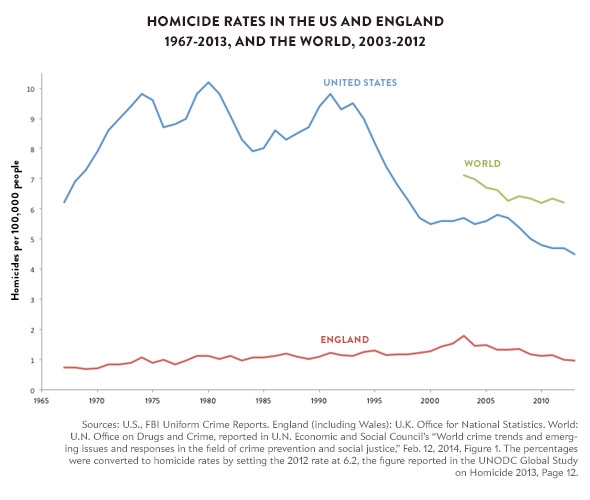
As the article points out, solid statistical evidence can be provided to illustrate how hugely important trends about violence and crime are improving vastly, contrary to the scary conclusions you might glean from media sensationalism.

For example, homicide rates are on a decreasing trend:


Democracy is on the rise, not, as you may believe, under threat from extremist ideologies seeking to plunge us into a new dark age of dogma-led theocracies:


State sponsored mass killings (e.g. Nazi holocaust, Stalin's purges or Khmer Rouge killing fields) are on the wane:


Likewise, deaths from armed conflicts are down. Your granny might be nostalgic for the War years, but the rest of us sure as hell shouldn't be:


And that's just a selection of such positive trends in the article. Read it and make your own mind up. Don't swallow the dark hearted media agenda of fear, be it consciously perpetuated (yes, Murdoch media, I'm thinking of you here) or just lazily reported.