Thursday, 21 May 2015

Standard of Living

The standard of living in the UK is something that has risen almost imperceptibly over the decades. It takes somebody who has spent a great many years on the planet, with a good recall of the past, to illustrate how what we regard as every day essentials used to be regarded as impossibly luxuriant dream goods.


Historian and writer William Woodruff wrote of his upbringing in the Blackburn of 1916 in his book The Road to Nab End. In what sounds today like a Pythonesque parody of northern poverty, Woodruff relates about people being woken at 5am, to walk to the mill in their clogs six days a week. Home consisted of a two-up-two-down house with a slate floor dusted with sand downstairs, and a boarded floor upstairs you could see through the gaps of and hear a conversation downstairs as if you were in the room. Woodruff and his brother shared a bed with their parents, and his two sisters shared a bed in the other room. During the depression of the 1920s they went without coal over winter for weeks, and without even stale bread to eat for days at a time.

You tell that to kids nowadays and they don't believe you, etc. etc.....

If you think that's extreme or far fetched, here's some government statistics that back up that what we used to consider an every day necessity sounds today like something out of the ark. And likewise, what we consider necessity today seems like a ridiculously flimsy nice-to-have by comparison.

The government has been measuring inflation using something called the Retail Price Index (RPI) since the 1950s. To do this they defined a shopping basket of 700 common consumer items of the day that they could measure the cost of over time to see whether the cost of living was going up or down. Conveniently, this also shows how our attitudes to what is a 'common consumer item' change over time.

In the 1950s, we regarded a mangle, some candles and some frozen cod as standard consumer items. By the 1970s that basket included Smash mashed potato, cassette recorders and duvets. By the 2000s we regarded MP3 players, mobile phones and fruit smoothies as being equivalent consumer items!

Source: BBC News in 2009
By the RPI basket of 2015 we have added on-line games console subscriptions, e-cigarettes and a streaming music subscription to our basket of essential items.

You tell that to kids in Blackburn in 1916 and they don't believe you, etc. etc.....

Source: The ONS 2015

Tuesday, 19 May 2015

Health & Safety NOT Going Mad

Contrary to what the Daily Mail would have you believe, health and safety is not going mad. It's one of the most ridiculous areas of self perpetuating mythology in the modern tabloid press, alongside its supposedly ever maddening little brother political correctness.

The mythology is so strong that the Health & Safety Executive (HSE) was motivated to keep a log of health and safety myths that had been reported as fact on numerous occasions by newspapers that really should know better if they weren't busy pedalling an agenda and unwilling to let the facts get in the way of a good story.


We've all heard the myths, everything from children being banned from playing conkers, office workers banned from putting up Christmas decorations, pin the tail on the donkey being banned, candy floss on a stick being outlawed, pantomime dames being banned from throwing sweets, pancake races being banned, adults being banned from putting plasters on kids etc. All of which totally untrue, but if the Daily Express and Daily Mail hadn't printed an of them they'd be reduced to a single sheet of A5 on most days.

Aberfan coal tip collapses onto a primary school in 1966 (Source: here)
Let's rewind a bit to understand why the concept of health and safety even came about. Following the industrial revolution, the rural poor got sucked into urban industrial jobs to escape the ever repeating cycle of famines and bad harvests for the promise of a captive source of income. The urban poor wasn't educated or particularly mobile, and so had to settle for whatever work was available to feed their families. At the time there was practically no legislation on workplace safety or public safety, meaning that unimaginably dangerous situations were allowed to exist at work and in public places causing deaths, often in hundreds at a time in a way that would be unthinkable today. In some cases, incredible lapses in basic safety were causing deaths in their hundreds well into recent years.

There were pit disasters with hundreds of deaths at a time, outbreaks of cholera due to appalling public sanitation, ships sinking without enough lifeboats for the number of people on board, gas explosions killing hundreds, mining waste piled high collapsing onto a school, there were fires in wooden stands and crushes in unsuitable stands at football matches, ferries that sank having set sail with their car doors open, tube station fires under rubbish filled escalators, fires in badly designed buildings made from flammable plastic, and so-on, all of which were preventable, and which caused from under a hundred to over a thousand deaths each.

Kids in mines with no safety gear (Source: socialstudieshelp.com)
Many famous buildings were built with an alarmingly high cost of human life to those workers building them. It is estimated that 30,000 people died building the Panama Canal and 500 died building Egypt's Aswan Dam, around a hundred workers died building the Hoover Dam and five workers died constructing the Empire State Building. Without some basic health and safety legislation in place, workers would still be dying in droves today, just like the estimated 900 construction deaths involved in building Quatar's World Cup venues. In the UK in 2013/2014 there were just two deaths per 100,000 workers, by contrast.

In many cases there was little or no legislation compelling companies to make sure their business wasn't profiting at the expense of hazard of death to the general public, The Health & Safety legislation that does now exist to deal with some of these glaring issues was brought in to deal with things like chemical hazards, the sale of dangerous goods, the use of things like lead and asbestos in construction, issuing of safety equipment to workers in dangerous conditions, and so on. You'll notice that there's precious little in there about conkers, Christmas decorations and pin the tail on the donkey.

The following HSE graph shows the decline in workplace deaths since 1974 from over 600 to fewer than 200 by 2014, as a direct result of better workplace safety. One can only imagine what the equivalent fatality figures were for Victorian times, where kids and adults alike worked dangerously long hours in dark, cramped conditions with heavy machinery and no safety gear:

Source: HSE stats on Workplace Deaths 1974 - 2014
If you want to point the finger at why some individual schools and business have chosen to put up a notice forbidding something relatively trivial on their premises, then look no further at the rise in litigious culture whereby parents will sue a business and seek compensation for an accident that befell their little Johnny. And that's the fault of societal greed and no-win-no-fee legal firms, not some left wing Health & Safety Gone Mad epidemic.

Monday, 11 May 2015

Improving Representativeness in Westminster - 2015 Election Update

Only a month ago, I covered the 'Improving Representativeness in Westminster'; a story of a continuing shift from a parliament once dominated exclusively by white, male, land-owning aristocracy to something which matches the demographics of the country a bit more closely. Since then, we've had a general election, and the situation has improved again.

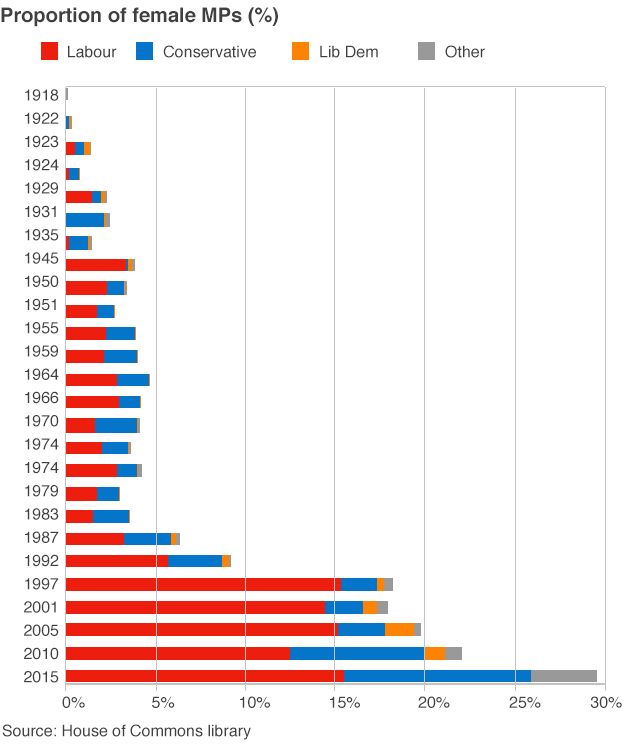
For example, as the BBC reported, the number of female MPs has risen by a third, from 147 to 191 (out of a total 650 MPs). That's now at about 30% of MPs, as opposed to about 23% before the election. A handy graph shows how that number has increased slowly over time:

Source: BBC News
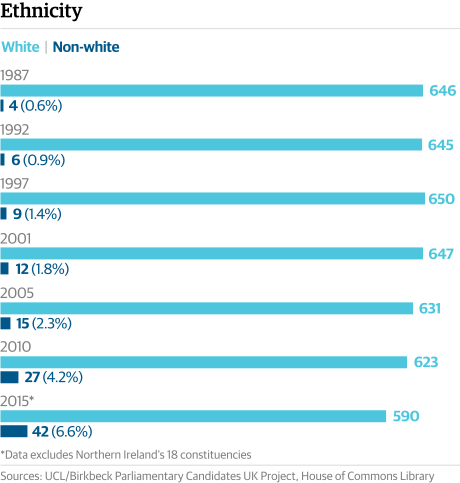
Similarly, The Guardian reported the rise of female MPs alongside the rising number of ethnic minority MPs. In the 2010 election there were 27 non-white MPs (4.2% of the total 650 MPs), rising to 42 in 2015 (6.6% of the total 650 MPs) where the current non-white demographic of the the UK is about 13%. Again, a handy graph shows how this trend is improving over time, now at over ten times the number of non-white MPs there were in 1987:

Source: The Guardian
Also, new Conservative MP Alan Mak, who is of Chinese-Malaysian background, is now the first MP of Chinese descent.

Also covered in the Guardian article, the number of privately educated MPs is dropping slowly too. In 2010 the percentage of privately educated Tory MPs was 54%, dropping to 40% in 2015. Likewise, in 2010 the percentage of privately educated Labour MPs was 14%, dropping to 11% in 2015.

The average age of MPs has hovered at around the 50 mark since 1979, but in this election the youngest MP since 1667 was elected in the shape of the SNP's 20-year-old Mhairi Black.

In terms of extremist parties getting seats, much was made of the fact that the predicted UKIP surge didn't materialise, where they actually lost one of the two seats they'd won in by-elections since 2010. But this doesn't mean that other right wing parties have prospered either, as the BNP won just 1,667 votes, which is 0.3% of the 563,743 votes they won in 2010. As the BBC points out, this election even the Cannabis Is Safer Than Alcohol Party won 8,419 votes, while the Monster Raving Loony Party reached 3,898 votes!

In terms of general public voting, this election was the highest voter turnout this century. where 66.1% of eligible voters registered their vote (up from 65.1% in 2010, 61.4% in 2005 and 59.4% in 2001). Also, the number of 18-to-25-year-olds who voted was 58%, up from 52% in 2010 and 38% in 2005. In Scotland, the turnout was 71.1%, which is up from 63.8% in 2010.

Again, there's a lot of positive trends there, but true representativeness is by no means a done deal quite yet.

Friday, 1 May 2015

Discovery of Extra-Solar Planets Has Rocketed

Extra-solar plantes, or "exoplanets", are planets that orbit stars other than our own. Finding exoplanets is important if the human race is ever to succeed in finding life elsewhere in the universe, or indeed settle on another planet.

The discipline of exoplanatology is the attempt to observe such planets in their orbits around distant stars, which is no mean feat given that even the nearest star is 4.24 light years away!

Three Exoplanets imaged by the Hale telescope (Source: Wikipedia)
Whilst exoplanets have been rumoured to exist since the 16th century, it was not until 1988 that the first one was discovered. The problem being that at that distance planets are so tiny as to be invisible even to the Hubble Space telescope directly, and their existence has to be inferred by measuring things like the tiny gravitational wobble they impart on their star or a  minuscule dimming of their star as they pass in front of it.

Even then, scientists were cautious in concluding that a planet had been detected. It wasn't until 1992 that two more were observed orbiting a pulsar, and observed with such a degree of certainty that their discovery was regarded as definitive.

Since then a variety of techniques have been used, including direct imaging, radial velocity, transit and gravitational lensing. And the number of exoplanets spotted has rocketed, if you'll excuse the pun, and in 2014 there were 800 exoplanet discoveries:

Source: The Smithsonian
And this is a field that can only continue to grow, particularly since the James Webb Space Telescope, which is 100 times as powerful as the Hubble Space Telescope, is due to be launched in 2018:

James Webb Space Telescope versus Hubble (Source: Wikipedia)

Tuesday, 28 April 2015

Real Things That Used To be Science Fiction

Futurology, the study of predicting future technological advancements, is littered with failed predictions of how we'd all be living in cloud cities and eating meals in pill form by now. But just recently there has been a rash of genuine inventions right out of Sci Fi, and these were published respectable journals on days other than April 1st.

For example, CNET are reporting a paper published in Nature from researchers from Griffith University and Swinburne University of Technology in Australia have successfully created a high-definition 3D holographic display with a wide viewing angle of up to 52 degrees, based on a digital holographic screen composed of small pixels that bend the light. While there is still work to be done, that's something straight out of Star Wars from 1976 that exists in the real world now.


Also, as Forbes reported, a flying car straight out of The Jetsons, being designed by AeroMobil, could go on sale as soon as 2017. Last year, the Slovakian company unveiled its latest prototype of an elongated, road-ready vehicle with stowable wings that can navigate both city traffic and the airspace in between landings and take-offs from the world’s airports.

Flying Car from AeroMobil
Another staple of classic sci fi like 2001 A Space Odyssey or Red Dwarf is a computer that you can talk to. These days, we're so used to Google Now, SIRI and Cortana on our phones that this technology has become mainstream. However. IBM is taking it very seriously and recently reorganised itself such that the Watson super computer that became champion of champions on the American game show  Jeopardy! has become one of Big Blue's main go-to-market business units. That means that they're setting its problem solving abilities off on complex healthcare and 'smarter cities' challenges that could really affect the way we live our lives in future.

IBM's Watson computer wins Jeopardy!
We've had about 20 years of science fiction works involving quantum computers. In 2011, Canadian company D-Wave  announced the D-Wave One quantum computer, sporting a 128 qubit processor. By 2012 they had announced the D-Wave Two, the world's first commercially available quantum computer. In 2013 NASA, Google and the USRA launched a Quantum Artificial Intelligence Lab using a 512-qubit D-Wave Two that would be used for research into machine learning. So, that's a pretty strong endorsement that it's a technology that has well and truly stepped out of the page and into the real world.

D-Wave 2 Commercial Quantum Computer
All very interesting, but where's my self driving car like the Johnny Cab in Total Recall? Well, here it is, thanks to Google, and it's not science fiction but it's science fact. It has been driving trials round San Francisco for a while now and, pending legislation, it will be coming to a road near you some time soon.

A Google Self Driving Car
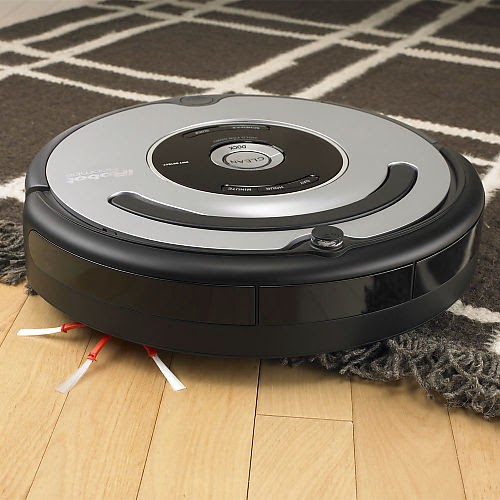
But what about robots that clean your house? Already done, and on the market with self-guiding vacuum cleaners like the Roomba.

Roomba vacuum cleaner robot.
If you add in a couple of recent 'stretch target' developments, things start to get very interesting. For example, IFLScience are reporting that NASA may have stumbled upon how to achieve Warp Drive, that staple technology of 1960s Star Trek episodes that drove the Starship Enterprise faster than the speed of light through the final frontier using an EMDrive electromagnetic thruster. Now NASA seems to have taken down the tentative announcement that IFL Science is referring to, but there's plenty of speculation on the matter elsewhere.

An EMDrive thruster prototype
Likewise, the space elevator, first proposed in science fiction by Arthur C Clarke as a cheap way of getting satellites and space craft into orbit, may be just over the horizon. Scientists at Penn State university have created strands of diamond nanotubes, which may be the strongest man made material yet created, which cold act as a lift cable for hoisting things into orbit, slung round a geostationary satellite (another Arthur C Clarke proposal that became reality).

Space Elevator (Source: Wikipedia)
At this rate there won't be much left in science to write fiction about.

Wednesday, 22 April 2015

Protected Habitat Has Grown From 4 to 18 Million Square Kilometres Since 1970

According to the United Nations Environment Programme's World Conservation Monitoring Centre (UNEP-WCMC) report in May 2010 the area of nationally designated protected nature areas has grown considerably since 1970.

In 1970 the total was just over 4 million square kilometres, whereas by the end of the report period it had grown to over 18 million square kilometres:

Source: cbd.int/gbo3/
By the time of the later GB04 report, the UNEP-WCMC was showing that at least 17 per cent of terrestrial and inland water areas are on track to be conserved.

The UNEP-WCMC was also tracking as one of its goals that the Nagoya Protocol on biodiversity would be signed and ratified, which it has been by 58 states and the EU. By helping to ensure benefit-sharing, the Protocol creates incentives to conserve and sustainably use genetic resources, and therefore enhances the contribution of biodiversity to development and human well-being.

Improving Representativeness in Westminster

The theme of this blog is about things that are getting better, not necessarily things that are fixed and wrongs that have been completely righted. As is the case with equality in the UK parliament.

The treaty known as Magna Carta, signed in 1215, wrestled power away from King John and allowed people other than the monarch to have a say in the running of the country. But it wasn't a sudden democratic revolution following which all sectors of society were proportionally represented in parliament. Far from it, in fact it moved power towards a group of 25 rebel barons who comprised a section of feudal aristocracy just below a viscount in prominence.

Slowly, these baronial representatives developed into the Knights of the Shire, who were usually wealthy landowners elected by the County Court presided over by the sheriff, which formed the precursor of the House of Commons in the year 1295. Even at this stage, the common man or woman could never hope to become one of these parliamentary representatives, and in fact the vast majority of the British public wasn't eligible to even vote for them.

It took until the 19th century for the British Houses of Commons to become even vaguely representative. By 1829 voting wasn't restricted by ethnicity, by 1918 there was universal male suffrage and by 1928 women were allowed the vote too.

Life peers (barons and baronesses) sitting in the House of Lords are still very much in effect, but since 1957 these are now appointed by the prime minister rather than the monarch and they are no longer inherited by the offspring of the peer without lifting a finger to earn it.

The net result of all this is that power has slowly ebbed away from (mostly male) monarchs and the (mostly male) landed gentry inheriting their power, and has ebbed towards something resembling a cross section of the people of the country a bit more.

For example, since the first female MP was elected in 1918 the number of female MPs has risen slowly to approximately 20% of all MPs (148 female MPs versus 502 male MPs), including of course the first female prime minister during that period in Margaret Thatcher, elected in 1979:


Also, since the introduction of pay for MPs in 1911 being a full time MP is now viable for those without an independent source of wealth (e.g. for those who aren't already rich landowners before they get elected), which wasn't true in years gone by, directly paving the way for the first predominantly working class government in 1923.

Nowadays, the make-up of parliament is less skewed than in days gone by. The average MP is pretty close to the average UK adult in ethnicity (as of the 2010 election there were 27 MPs out of 650 from an ethnic minority) and the average MP is only marginally older than the average adult. MPs are much more likely to be a university graduate than the average adult, which is perhaps understandable given that it's a professional grade job. The two remaining glaring issues remain private schooling and gender, although the latter is at least improving as we have seen above:
Source parliament.uk
In terms of sexuality of MPs, the first MP to be outed as gay was in 1976. Since then we had the first MP come out whilst in office in 1984, the first openly gay parliamentary candidate elected in 1997, the first MP in a civil partnership in 2006, the first bisexual MP in 2013 and LGBT MPs from Labour, Plaid Cymru, the Lib Dems and the Conservatives.

In the House of Lords, the biggest party affiliation of lords is conservatives at 224, compared to the next nearest party which is Labour with 215 peers. So, gone are the days when landed gentry Whigs and Tories populated the lords exclusively, things are a bit more representative now.

This representativeness is an evolving process. To be truly representative of this nation parliament would have to become something like the following:
  • 50.9% would be female
  • 1.1% would be lesbian or gay, with 0.4 being bisexual and about 4% being unsure or 'other' and so on...
  • 87% would be white, 7% Asian, 3% black and about 2% mixed race and so on...
  • 59% would be Christian, 26% would have no religion, 4.5% would be Muslim, 1.5% Hindu and so on...
  • 7% would be educated in private schools, 
  • 0.2% of MPs who are graduates would have graduated from Oxbridge (based on 2000 Oxbridge students per year out of 1 million total graduates per year)
So, there's a long way to go, but the trend is towards a more representative Westminster than ever before.