Monday, 23 February 2015
Is War Over? Maybe.
A bit premature, perhaps, but things are undoubtedly better than they were in the past, no matter how many localised conflicts there are today:

New Solar Cell Efficiency Record Set
If solar energy is to become a truly viable means of sustainably generating electricity that replace nuclear or fossil fuels then it must become more efficient.
Soitec and CEA-Leti (France) and the Fraunhofer Institute for Solar Energy Systems ISE (Germany) have just set a world record for the efficiency of their new solar cell, beating their own previous record set in 2013.


Soitec and CEA-Leti (France) and the Fraunhofer Institute for Solar Energy Systems ISE (Germany) have just set a world record for the efficiency of their new solar cell, beating their own previous record set in 2013.
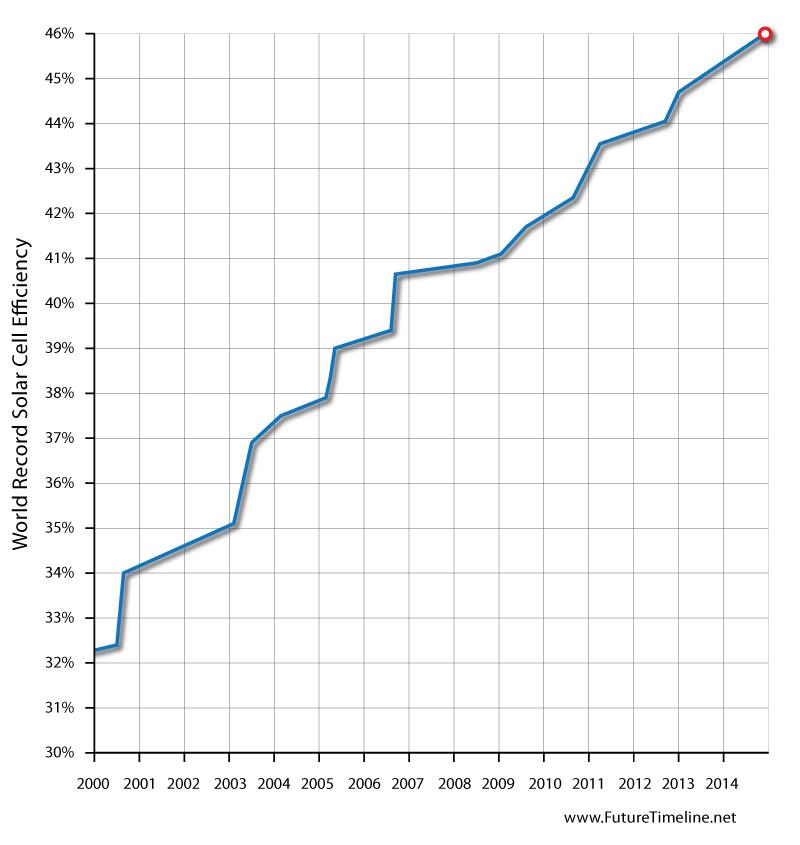
That means that solar cell efficiency has increased from just over 32% in the year 2000 to 46% today.
That's not just going to be very important for those countries like the UK that aren't overly blessed with much sun, but also such efficiency would make a huge impact on the huge solar farms starting to pop up in desert regions:

Attitudes to Homosexuality
One area of undeniable progress which humanity is making is in terms of attitudes to homosexuality. Where once societies repressed their gay populations, imprisoned them, tortured or killed them or simply bullied them into going underground, there are signs that humanity is at last lightening up and righting some injustices.
Let's be clear, no matter what your personal opinions on homosexuality are, no repressive society has really ever eradicated homosexuality. They might have terrified their gay population into living a lie for a while, or hiding their true selves from the authorities, but no dictatorship or extremist regime has really succeeded in its aim in squashing their gay population. And that's for one simple reason; homosexuality has always existed and it always will, which is why enlightened nations have started acknowledging this fact and legally enshrining gay rights.
One nice graph that summarises this neatly comes from the Future Timeline website which plots the number of countries since 1790 that made homosexuality illegal versus the number in which gay marriage is now legal. Whilst the latter is still the minority, it's projected that by the mid 2040's countries that permit gay marriage will become the majority:
The really encouraging thing about all this is that this shift in legislation wasn't a top-down thing imposed upon us by our governments, it reflects changes in societal attitudes. The populations of many countries are living with gay friends, colleagues and neighbours on a daily basis and have discovered that they're not the Antichrist as some mediaeval doctrines would have you believe.
That has resulted in a world which is increasingly heading towards acceptance of homosexuality (as shown by the blue countries), albeit with a long way to go:
This means that should an Alan Turing like genius be born today in one of those blue countries he would be permitted to go about his lawful business, rather than being convicted of gross indecency, chemically castrated with appalling physical side effects and ultimately caused to take his own life through the unbearable shame of it all. And that's how we used to treat a genius who helped break the Nazi's enigma code and shorten WWII by potentially years!
Let's be clear, no matter what your personal opinions on homosexuality are, no repressive society has really ever eradicated homosexuality. They might have terrified their gay population into living a lie for a while, or hiding their true selves from the authorities, but no dictatorship or extremist regime has really succeeded in its aim in squashing their gay population. And that's for one simple reason; homosexuality has always existed and it always will, which is why enlightened nations have started acknowledging this fact and legally enshrining gay rights.
One nice graph that summarises this neatly comes from the Future Timeline website which plots the number of countries since 1790 that made homosexuality illegal versus the number in which gay marriage is now legal. Whilst the latter is still the minority, it's projected that by the mid 2040's countries that permit gay marriage will become the majority:
 |
| Source: futuretimeline.net |
That's reflected in societal attitudes which are measurable quantitatively, as per the following graph. It shows that the proportion of population which regard homosexuality as "never justifiable" has dropped steadily from, in the UK case, 47% in 1981 to 21% in 2006:
 |
| Source: thesocietypages.net |
That has resulted in a world which is increasingly heading towards acceptance of homosexuality (as shown by the blue countries), albeit with a long way to go:
 |
| Source: Loopy Lettuce Blog |
That's on injustice that the UK has recently atoned for, by formally issuing a royal pardon for Alan Turing. And the world is a more enlightened place than it once was for that fact alone.
The Economy - Some Good News for a Change
The economy is notoriously difficult to write good news articles about, partly because of the obvious downturn of recent years, but also because one man's good news is another person's bad news. So it's worth dwelling on some unequivocal good news stories when they show themselves. I'm no apologist for the current government and their policies, but let's not moan and whinge to the exclusion of acknowledging some god news when it happens, eh?
The following article from the BBC News site contains some figures aimed at giving voters a means to visualise some key figures for the upcoming election on which to base their voting decisions. Amongst them are one or two good news stories that don't perhaps make the front pages in our rush to dwell on the sensationalism of a good old fashioned doom and gloom story.
For example, gross domestic product is higher than ten years ago, despite the financial crisis that happened in between:

And wages are starting to creep up and overtake the cost of living:

Also, employment rates are starting to creep up back to pre-crisis levels. Check out the slumps in employment in the mid eighties and early nineties for what a proper unemployment crisis looks like, by the way:

Lets hope this mini-recovery continues.
Thursday, 19 February 2015
Divorce Rates down nearly 30% from 1993 high
According to official Office for National Statistics (ONS) stats published on the Guardian website, divorce rates today are nearly 30% lower than they were at their all time high in 1993:

In 1993 165,018 divorces occurred, whereas by 2012 that was down 28% to 118,140.
The graph above would tend to show that, once the rise of divorces during the 50s and 60s due to the reduced social stigma of separation had abated, divorces have been on a long term downward trend since the early 1990s.
Energy Generation for Renewable Sources Continues to Rise
The Office for National Statistics stats for the proportion of energy generated from renewable sources continue to show a show a positive trend.
For example, renewables’ share of electricity generation was 17.8 per cent in 2014, up from just 8% back in 2011:


An on-line co-generation magazine website called COSPP.com is reporting that efficiency benefits have led to over 15 million tonnes of CO2 savings, equivalent to removing 5 million cars from the road and representing an increase of 2 million tonnes over the previous year.
For example, renewables’ share of electricity generation was 17.8 per cent in 2014, up from just 8% back in 2011:
One reason for this might be that Bioenergy generation increased by 1.4 terrawatt-hours to 6.0 terrawatt-hours in 2014, largely due to the conversion of Drax Unit 2 earlier in 2014 to run on biomass waste.
Also, the amount of solar panel capacity which is eligible to recieve a tariff through topping up the energy on the national grid. It's up to 3000 milliwatts from just 200 milliwatts in 2011:
The Giving Pledge
The richest 400 Americans are worth over $2 trillion. In other words, they own as much wealth as the bottom half of American households combined. However, there's a new move towards philanthropy amongst the American super-rich instigated by the likes of Bill Gates and Warren Buffett.

The Giving Pledge is a long-term charitable initiative that aims to inspire immediate philanthropy and increase charitable giving throughout the United States. An estimate of the contribution promised by the first 40 donors, based on their aggregate wealth as at August 2010, was at least $125 billion.

Now in its fourth year, the Giving Pledge has shown strong momentum in encouraging billionaires to give away at least half of their fortunes to charitable causes. In 2013, the Pledge was opened up to international signatories, inviting pledgers from around the world to share their unique approaches to giving and lend their voices to a wider range of global issues in need of philanthropic investment.
As of January 2015, 128 billionaire or former billionaire individuals and couples have signed the pledge. Pledgers signed up to the scheme are listed on the schem's web page here: givingpledge.org
Subscribe to:
Posts (Atom)