Wednesday, 19 November 2014

Death By War is Decreasing

Your granny might be nostalgic for the old days when she felt secure, not like today with all these wars going on everywhere.

But despite what you read about the current situation in Ukraine, Syria, Israel and various conflicts in central and northern Africa, we live in relatively peaceful times compared to the 50 - 80 million people killed in WWII for example:


Life before the 20th century was largely miserable, violent, brutish and short. Even taking into account that the 20th Century contained both WWI (37 million deaths) and WWII (50 - 80 million deaths) the 20th Century was relatively tame by comparison to older civilisations. The following graph shows the percentage of male deaths in various societies caused by war:
But what about the rise in the number of recent conflicts in different regions going on simultaneously? That's a new thing, right? Wrong:


Literacy Levels are Improving

You might be forgiven from reading the national media for thinking that we are churning out a generation of illiterate kids with the attention span of a gnat. This seems to be the common conception of modern education, except that it's a misconception.

According to the National Literacy Trust's State of the Nation and Impact Report 2013/2014 there are some encouraging upwards trends in the nation's school literacy attainment levels. Here's a selection of those upward trends:

Key Stage 1 Phonics:


Key Stage 1 Phonics Reading / Writing:


Key Stage 2:


GCSE English Attainment:


Enjoyment of Reading:


And this picture is repeated internationally too (Source: Literacy Rates around the World from the 15th century to now taken from ourworldindata.org):


Global Extreme Poverty is Declining

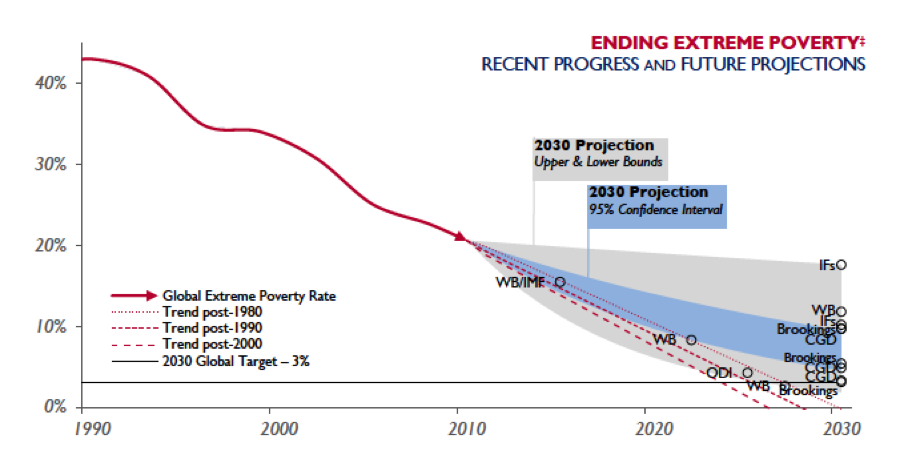
Since the mid-1990s, there has been a steady decline in both the worldwide poverty rate and the total number of extreme poor. In 1990, the percentage of the global population living in extreme poverty was 43.1%, but in 2010, that percentage had dropped down to 20.6%. This halving of the extreme poverty rate falls in line with the first millennium development goal (MDG1) proposed by former UN Secretary-General Kofi Annan, who called on the international community at the turn of the century to “halv[e] the proportion of people living in extreme poverty…by 2015.”:

(Source: http://en.wikipedia.org/wiki/Extreme_poverty)


Class A Drug Use is Declining

The use of Class A drugs amongst young adults in the UK is declining, down from 10% in 1999/2000 to 7% in 2010/2011 (source: poverty.org.uk):


The Universe is More Amazing Than We Could Ever Have Imagined

With the rise of scientific rationalism and enlightened thinking, and the subsequent decline in basing what we know purely on superstitious or purely faith-based belief systems, it might be easy to believe we've taken the mystery, majesty and awe out of our understanding of the universe around us.

In fact, the Universe turns out to be more mind-blowing than we ever could have imagined in our early belief systems. Not only is the Universe not confined to the seven moveable celestial bodies we've always been able to see with the human eye (Sun, Moon, Mars, Mercury, Venus, Jupiter and Saturn - after which the days are named) and a few thousand stars, it's actually unfathomably richer and more unbelievably vast than that.

If you pick a section of the sky in which there appears to be nothing and point a powerful telescope at it, it turns out there's gazillions of celestial objects in it:


It's so vast in fact that it's difficult to conceive of the relative sizes of these objects. Here's a comparison of the size of the earth to various planets and stars:


And that's just a comparison based on zooming out from the size of the Earth. What happens when we zoom in? Prepare to have your mind blown by this interactive zoomable model of the scale of the universe: http://htwins.net/scale2/

Crime is Falling

There's ever more crime and disorder in our streets than there used to be, right? Wrong. According to the ONS crime fell 16% in England and Wales according to Crime Survey figures. Following a peak in the early 1990's, recorded violent and sexual crime is now back down to where it was in the early 1980's and predicted to fall further (source: ONS):


An article in the Economist in July 2013 suggested this could be because: 
"The crack cocaine and heroin epidemics of the 1980s and 1990s have largely burnt out. Electronic crime and fraud has distracted some professional criminals from traditional ways of stealing stuff. Policing has improved, and more people are locked up in prison. The two wildest ideas are the introduction of legal abortion and the phaseout of leaded petrol."
According to the Office for National Statistics (ONS) Crime Statistics, period ending March 2013 were as follows:
  • Latest figures from the Crime Survey for England and Wales (CSEW) estimate that there were 8.6 million crimes in England and Wales, based on interviews with a representative sample of households and resident adults in the year ending March 2013. This represents a 9% decrease compared with the previous year’s survey. This latest estimate is the lowest since the survey began in 1981 and is now less than half its peak level in 1995.
  • The CSEW also estimated that there were an additional 0.8 million crimes against children aged 10 to 15 resident in the household population.
  • The police recorded 3.7 million offences in the year ending March 2013, a decrease of 7% compared with the previous year. This is the lowest level since 2002/03 when the last major change in police recording practice was introduced.
  • Victim-based crime accounted for 83% of all police recorded crime (3.1 million offences) and fell by 9% in the year ending March 2013 compared with the previous year. The volume of offences recorded in this category is equivalent to 55 recorded offences per 1,000 population.
  • Other crimes against society recorded by the police (402,615 offences) showed a decrease of 10% compared with the previous year.
  • In the year ending March 2013, 229,018 fraud offences were recorded by the police. This represents a volume increase of 27% compared with the previous year and should be seen in the context of a move to centralised recording of fraud.
  • Within victim-based crime there were decreases across all the main categories of recorded crime compared with the previous year, except for theft from the person (up 9%) and sexual offences (1% increase). The latter increase is thought to be partly a ‘Yewtree effect’, whereby greater numbers of victims of sexual offences have come forward to report historical offences to the police.
  • There were an additional 1.0 million offences dealt with by the courts in the year ending December 2012 (the latest period for which data are available), which are not included in the police recorded crime figures. These cover less serious crimes, such as speeding offences, which are dealt with no higher than magistrates courts.

Life Expectancy is on the Rise

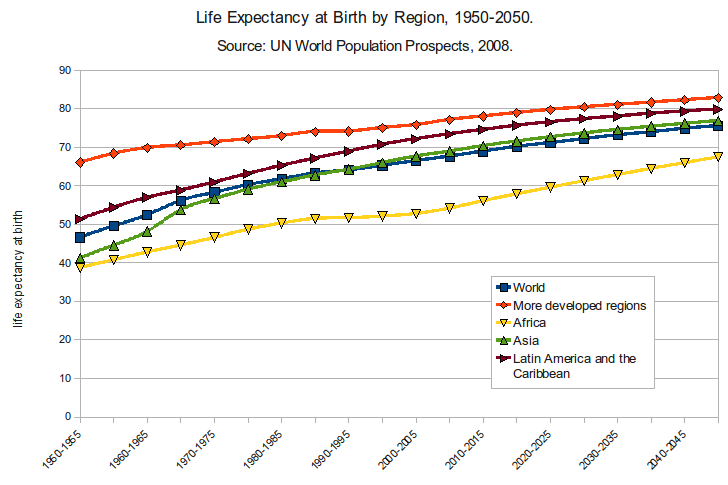
Life expectancy is on the rise, and is projected to keep on rising. Between 1960 and 2045 the average world life expectancy will rise from the mid 40s to the mid 70s, so people born at the end of that period can expect to live 30 years longer than people born at the start of it (source: Wikipedia):


In the UK, the rise can be shown even on a shorter period. Between 1980 and 2010 we added about ten years to the life expectancy of a new born baby (source: ONS):


Check out this info-graphic from the UK Office for National Statistics (ONS) on the topic: